

There is no set number of driving lessons. The question every learner asks is how many lessons do I need, and the honest answer is that most people take between 30 and 60 hours with a driving instructor.
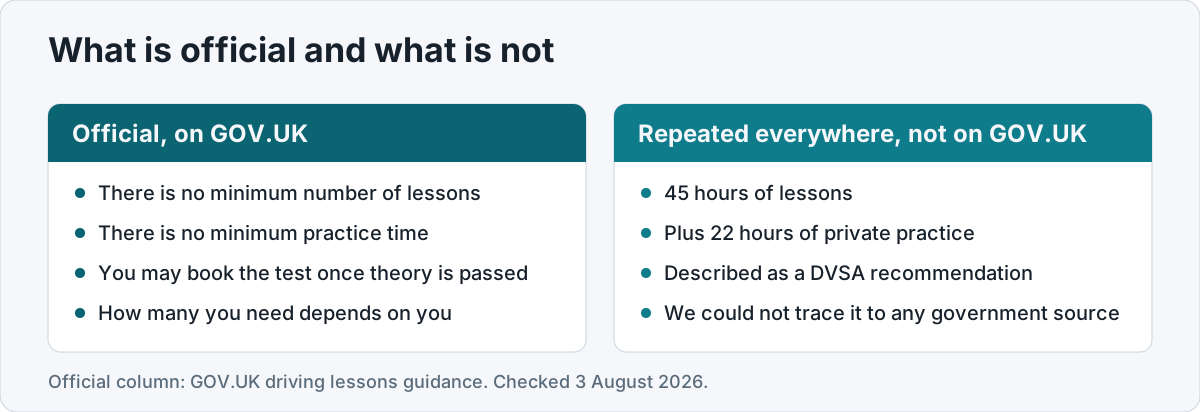
You will see 45 hours quoted everywhere as official guidance. It is not, and that matters, because plenty of people book lessons they do not need trying to hit it.
Key facts
- Minimum lessons required by law
- none
- Typical range
- 30 to 60 hours of lessons
- Practical test pass rate
- 50.0%, year to March 2026
- First attempt pass rate
- 50.5%. Second attempt: 50.8%
- Theory certificate valid
- 2 years
How many driving lessons will I need?
There is no minimum. The GOV.UK guidance puts it in one line: “There’s no minimum number of lessons you must have or hours you must practise driving”.
In practice most learners land between 30 and 60 hours with an instructor. That is a wide range because the people in it are very different, and where you sit in it says almost nothing about you.
You can legally book your practical driving test the day you pass your theory test, with no lessons at all behind you. Almost nobody should, but the rule is worth knowing, because it means nobody is holding you to a quota.
Counting hours is a poor way to think about this anyway. Your instructor is not counting hours. They are watching for whether you can hold a whole drive together without help.
Is the 45 hours figure official?
No. It does not appear anywhere on GOV.UK, and the live guidance says there is no minimum number of lessons at all.
The full version usually quoted is 45 hours of professional lessons plus 22 hours of private practice, presented as a DVSA recommendation. Search GOV.UK for it and you will not find it. We could not trace it to any government source, and every page stating it as official is quoting another page that quoted another page.
It is not a useless number. As a rough average of what people report, it is about the right shape, and the underlying point about private practice is sound. But it was never a rule and it was never a target.
The damage it does is real. Learners at hour 50 decide they are failing. Learners at hour 25 book a test they are not ready for because they are “ahead”. Both are reacting to a number that does not apply to them.
From the passenger seat
Ask your instructor this at lesson 10. “If I keep going at this rate, roughly when do you think I will be ready?” They have already worked it out and are waiting to be asked. Their estimate beats every national average on the internet, because they have watched you drive and the internet has not.
What changes how many lessons you need?
How often you drive, whether you get private practice, your age, and whether you learn in a manual or an automatic.
How often you drive. This is the big one. Weekly lessons beat fortnightly by a long way, and a three week gap costs you most of the lesson that follows it. Two shorter lessons a week will get you there on fewer total hours than one long one a fortnight.
Private practice. Time in a family car between lessons is the cheapest hour of driving you will ever get. Your supervisor needs to be over 21 and have held a full licence for that type of car for 3 years, and they cannot be paid for it.
Your age. Younger learners tend to need fewer hours. It is a tendency and not a rule, and plenty of people in their thirties pass quickly.
Manual or automatic. There is less to do with your hands and feet in an automatic, so most people reach test standard in fewer hours.
What you are starting from. If you have driven on private land, ridden a motorbike, or grown up around cars, some of this is already familiar. If you already drive and have moved to the UK from abroad, you will need far fewer hours than a beginner.
How do you know when you are ready for the test?
When you can drive a whole lesson without your instructor saying anything. That is the real standard, and your instructor is quietly running that test already.
Not “without making a mistake”. Everyone makes mistakes and the test allows up to 15 driving faults. The standard is whether you spot and fix things yourself, without a voice from the passenger seat.
The other signal is boredom. When roundabouts stop being an event and start being a thing you do on the way somewhere, you are close.
Book the test before you feel ready, though. The median wait between booking a practical and taking it was 10.7 weeks across Great Britain in June 2026, so the queue does the waiting for you. Our guide to how long it takes to learn to drive has the regional figures.
Does taking more lessons mean you will pass?
Not on its own. Half of people pass first time, and people sitting the test a second time pass at almost exactly the same rate. More driving improves your odds. More tests do not.
The DVSA test data tables for the year to March 2026 are worth sitting with. Of 984,415 people taking the practical driving test for the first time, 50.5% passed. Of 495,742 taking it a second time, 50.8% passed. The third time round it was 49.8%.
Read that again, because it contradicts the comforting thing everyone says. The second test is not easier. It is the same test, passed by about the same share of people.
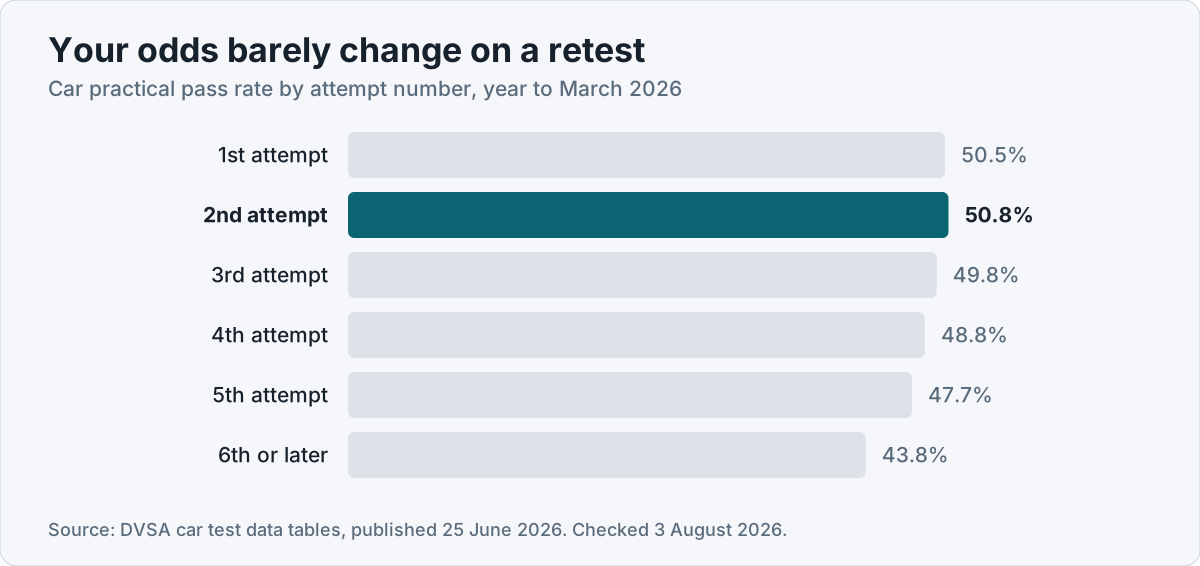
What that tells you is useful. Sitting the test again is not a plan. Turning up better prepared is. If you failed on observations at junctions, the fix is lessons on junctions, not a rebooked date and hope.
It also means a fail is not a signal that you are close. Plenty of people fail three times and pass the fourth, not because they ran out of bad luck, but because somewhere in there they got better.
Here is the hopeful half, and it is genuine. About a million people passed their practical driving test in the year to March 2026. The pass rate has risen for three years running and reached 50.0%, the highest it has been in over a decade. This is not a test built to catch you out.
Should you take an intensive course instead?
Only if you already drive a bit, or you have a hard deadline. Intensive courses compress lessons into a week or two, and they suit confident learners far better than nervous ones.
The pitch is appealing: 30 or 40 hours in a fortnight, test at the end. For someone who has driven on private land or ridden a motorbike, that can work well.
For a complete beginner it is a lot. Driving is a physical skill, and physical skills settle in the gaps between practice sessions. Cram them together and some of that settling never happens.
There is a practical catch too. An intensive course does not shorten the queue for a test, so you need the test date booked before you book the course. Otherwise you finish 40 hours of driving and then wait ten weeks, which is the worst of both.
Instructors teach in both manual and automatic cars, and the choice matters here as well. An automatic removes the clutch, which is the single thing most beginners spend an intensive week fighting. Our comparison of manual and automatic lessons goes through the trade.
Common questions
Is 20 driving lessons enough?
For some people, yes, particularly in an automatic with regular private practice. For most it is early. Twenty hours is roughly where the basics stop being frightening, which is not the same as test ready.
How many lessons before I book my test?
Book the test well before you finish your lessons. With a median wait of around 10 weeks, booking at lesson 15 to 20 usually means the date arrives at about the right time.
Can I take my test after 10 lessons?
Legally yes, since there is no minimum. Realistically you would be paying £62 for a lesson in what a test feels like. Most instructors will tell you honestly if you ask.
How many driving lessons a week should I have?
One or two suits most people. Two if you have a test booked or you are picking things up quickly. Less than one a week and you start each lesson recovering the last one.
Do I need private practice as well as lessons?
You do not need it, but it helps more than anything else you can do for free. Learners who mix instructor lessons with private practice generally need fewer paid hours.
Is there a maximum number of driving lessons?
No. There is no cap and no limit on test attempts either. Some people need 80 hours, and that is a fact about how long they took, not a verdict on them.
